











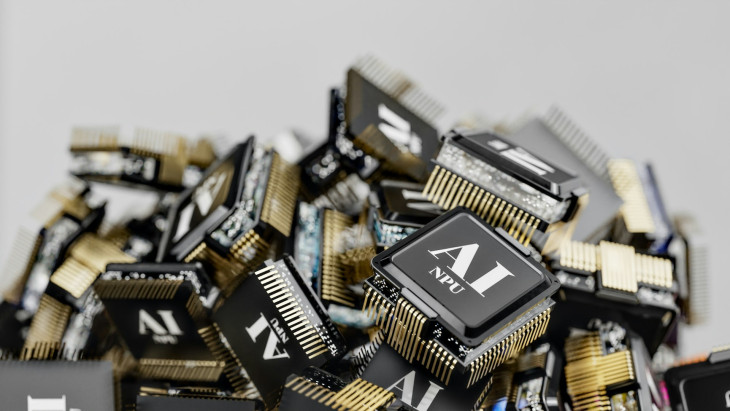
An artificial intelligence (AI) accelerator can have an advanced architecture and exceptional compute density, yet still be constrained by its heat dissipation capacity. As AI, 5G and high-power optics hardware push heat flux higher, thermal management for AI chips is becoming a manufacturing challenge as much as a design problem.
For industrial manufacturers, the challenge extends beyond material selection or adding surface area. Producing compact cold plates, microscopic channels and precise mating surfaces requires the manufacturing accuracy needed to deliver predictable thermal performance.
Heat Flux Is Driving Cooling Beyond Conventional Heatsinks
The thermal problem begins at the chip level. Higher integration and power density concentrate more heat into smaller areas, increasing the thermal resistance that the cooling stack must overcome. A 2024 review of roughly 400 studies examined chip-scale thermal management approaches ranging from air and microchannel cooling to embedded, immersion, spray and two-phase systems.
Recent research identifies a shift from nonembedded to embedded cooling, with reported heat-dissipation capacity increasing from about 200 W/cm² to more than 1,000 W/cm². Also noted is a transition from conventional channels to microchannels.
The pressure extends beyond individual processors. The International Energy Agency estimates that data centers consumed about 415 TWh of electricity in 2024. Cooling accounts for roughly 7% of consumption in efficient hyperscale facilities and more than 30% in less-efficient enterprise facilities.
Tennessee provides a striking example of how concentrated AI infrastructure can become. Four data centers in the state reportedly house 1.27 million AI chips. At that scale, thermal management becomes a systems-level manufacturing challenge. It requires cooling hardware that can remove substantial heat loads while fitting within increasingly constrained physical footprints.
This is why chip heatsinks are evolving from relatively simple fin structures into engineered thermal systems.
Microchannels Turn the Heatsink Into a Precision Component
Microchannel cold plates attack the thermal problem by increasing heat-transfer area within a compact volume. Instead of relying primarily on external fins, they route coolant through precisely engineered internal passages positioned close to the heat source.
That geometry introduces a manufacturing problem. Channel dimensions, manifold design, surface condition and flow distribution all influence thermal-hydraulic performance. A 2025 study of multilayer microchannel cold plates found that manifold configuration substantially affected thermal resistance and pressure drop. Its optimized design achieved a 206.5 W/cm² chip-area-averaged heat flux with a thermal resistance of 0.1727 K/W.
More channels do not automatically produce better cooling. Increasing channel density can improve heat transfer while increasing pressure drop and fabrication complexity. Another 2025 study found that modifying rib geometry reduced thermal resistance by 12% in one configuration while increasing the convective heat-transfer coefficient by 18%.
For manufacturers, the takeaway is straightforward. The cooling architecture must be manufactured with the same precision built into its design.
Copper Demands Precision
Copper can support advanced thermal-management components, but machining intricate cooling geometries requires careful process control. A 2022 study examined micro-milling Ω-shaped reentrant microchannels in pure copper, focusing on burr formation along the channel edges. The researchers found that side burrs formed primarily on the up-milling side, with some extending from the circular cavity’s sidewall toward the top exit slot.
For manufacturers, the finding highlights why edge quality matters when producing intricate cooling structures. Toolpath strategy, cutting direction and burr formation can all influence the finished geometry, making machining control an important part of producing precision thermal-management components.
Accuracy and Repeatability Shape Thermal Performance
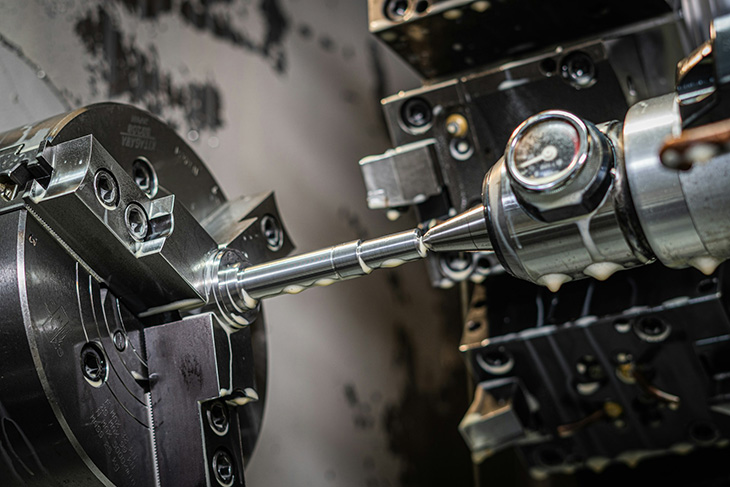
Manufacturing complex thermal components depends on machine-tool performance, particularly when producing microscopic channels, tight mating surfaces and intricate heatsink geometries. Accuracy and repeatability are independent performance characteristics — accuracy measures how closely a machine reaches its commanded position, while repeatability measures how consistently it returns to that position across cycles.
For thermal components, both metrics influence manufacturing consistency and, ultimately, thermal performance. A machine can repeatedly produce a feature with the same offset. However, if that offset shifts channel dimensions, surface alignment or mating geometry from the intended specification, the component may deliver less predictable heat transfer.
Conversely, high positional accuracy without sufficient repeatability can introduce variation between production cycles. Manufacturers, therefore, need machine tools that can maintain both characteristics when fabricating the geometries that determine coolant flow, contact quality and heat dissipation.
The Thermal Interface Cannot Be an Afterthought
Even an exceptionally machined cold plate can underperform if the interface between the chip package and cooler introduces excessive thermal resistance.
Research published in 2024 identifies thermal conductivity, bond-line thickness and contact resistance as important factors in thermal interface performance. Increasing effective contact between mating surfaces can also improve heat transfer.
The thermal interface adds another variable. A flip-chip model found that friction, pressure and thermal interface material (TIM) elasticity affect thermal contact resistance by changing the actual contact area. Thermal conductivity, the interstitial medium and convective heat transfer have a greater influence on overall heat dissipation. Temperature changes can also alter contact stiffness and thermal resistance.
The takeaway is to optimize the entire thermal stack, from TIM properties and mating surfaces to the cold plate and coolant flow, rather than treating each component independently.
Build the Cooling System Around the Manufacturing Process
The next generation of AI cooling will require closer collaboration between thermal engineers, semiconductor designers and precision manufacturers. Computational fluid dynamics can optimize channel architectures, but production engineering must ensure those designs can be machined, inspected and qualified consistently.
Manufacturers should evaluate thermal resistance, pressure drop, flow uniformity, surface finish, dimensional accuracy and repeatability together. A poorly controlled cooling component can ultimately become the bottleneck limiting a processor’s designed performance.
The Cooling Hardware Is Part of the Compute Architecture
As AI hardware pushes higher heat flux into tighter form factors, chip heatsinks increasingly depend on precision manufacturing. Their geometry, materials and interfaces can determine whether processors sustain designed performance, making thermal components an integral part of semiconductor engineering.