







Radish microgreens are an excellent choice for growers looking for fast and productive cultivation of fresh greens. Their short growth cycle allows for frequent harvests, which is particularly important in commercial production. However, ensuring a regular supply of young shoots requires more than a single sowing. Proper planning, seed selection, and maintaining stable growing conditions are essential for achieving consistent results.
Why are radish microgreens suitable for continuous production?
One of the biggest advantages of radish microgreens is their rapid growth. Under favorable conditions, young shoots can be ready for harvesting in approximately 6-10 days. This makes it possible to complete several production cycles within a month, even in a relatively small growing area.
Another advantage is their versatility in professional kitchens. Their crunchy texture, vibrant colors, and distinctive peppery flavor make them popular ingredients in salads, sandwiches, and decorative garnishes. Regular production allows growers to supply fresh microgreens according to customer demand.
How to plan sowing to avoid gaps between harvests?
The foundation of continuous production is a well-organized sowing schedule. Instead of planting all seeds at once, it is better to prepare new growing trays every few days. This allows individual batches to reach harvesting maturity at different times.
When planning production, consider the following factors:
- expected germination and growth time of the selected variety;
- number of growing trays available for each production cycle;
- quantity of microgreens required to fulfill orders;
- lighting conditions and temperature in the growing area;
- time needed to prepare growing equipment for the next sowing.
A well-designed schedule reduces the risk of overproduction and helps growers use available space more efficiently. This is particularly important for producers supplying restaurants and catering businesses.
How important is the choice of radish microgreens seeds?
Seeds are the foundation of every successful crop, and their characteristics directly affect production predictability. For regular harvests, high germination rates and uniform plant development are particularly important. Seeds with inconsistent germination performance may result in uneven growth, making it more difficult to schedule harvesting.
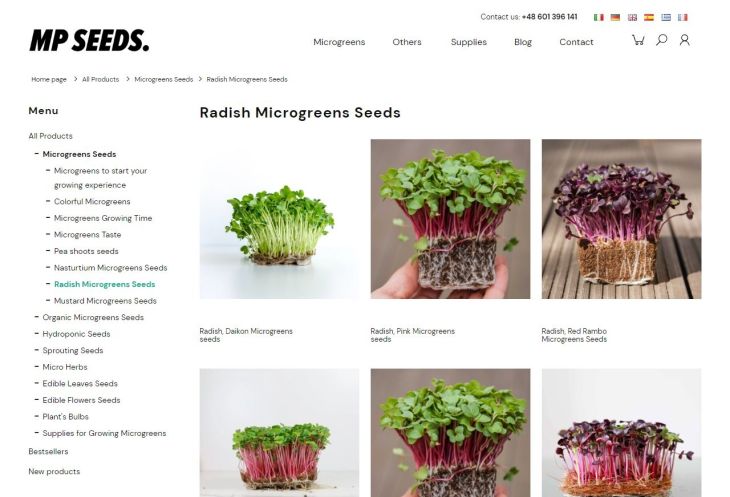
When choosing radish microgreens seeds for professional growing, it is worth considering the available varieties and their specific characteristics. The MP Seeds selection includes Daikon, Red Rambo, Pink, Rose, and radish mixes. This allows growers to select seeds that match the desired appearance and intended use of the harvested microgreens.
Carefully selected radish microgreens seeds make it easier to maintain consistency across successive growing cycles. This is particularly important in commercial production, where reliable deliveries play a significant role in maintaining customer relationships.
How to maintain suitable conditions throughout successive growing cycles?
Stable growing conditions are essential for achieving uniform harvests. Radish microgreens require appropriate moisture levels, temperature, and access to light. Sudden changes in these parameters can lead to differences in growth rates, even when individual batches come from the same seed lot.
Particular attention should be paid to watering. The growing medium should remain moist, but excessive water can encourage mold development. Proper air circulation is equally significant, especially in growing facilities where numerous trays are cultivated simultaneously.
In professional cultivation, keeping records of temperature, humidity, and growing time can be particularly useful. Such information allows growers to compare results and gradually improve production organization.
When should radish microgreens be harvested to maintain freshness?
Harvesting time should be adjusted according to plant development and the intended use of the final product. Radish microgreens are generally harvested once their cotyledons have fully developed and the shoots have reached the desired height and coloration.
Clean, sharp tools should be used during harvesting to ensure precise cutting. Microgreens should be handled carefully and transferred to suitable refrigerated conditions as quickly as possible. Minimizing mechanical damage helps preserve their attractive appearance and crunchy texture.
For regular commercial deliveries, it is worth scheduling harvests as close as possible to the planned delivery date. This reduces storage time and helps provide customers with fresh microgreens that retain their desirable culinary characteristics.
How to increase production efficiency without expanding your growing area?
Increasing production does not always require additional growing space. Better results can often be achieved through improved work organization, appropriate sowing density, and reducing losses during germination and harvesting.
Seed consistency also plays an important role. Using reliable radish microgreens seeds makes it easier to compare the results of successive growing cycles and plan the use of available trays. Regularly analyzing harvest yields can also help identify which cultivation practices deliver the best results.
Properly planned radish microgreens production makes it possible to achieve fresh harvests at short intervals. Combining carefully selected seeds, stable growing conditions, and a well-organized sowing schedule provides a solid foundation for efficient cultivation on both a small and commercial scale.