





As wire arc additive manufacturing moves beyond demonstration projects, the real test is whether it can deliver qualified components at industrial scale. DEEP Manufacturing CEO Peter Richards explains why certification, production economics and an increasingly sophisticated supplier ecosystem will determine what happens next. The promise of metal additive manufacturing has always been seductive: manufacture complex components directly from digital designs, use material more efficiently and shorten the long lead times associated with conventional production. For industries dependent on large, expensive metal parts, the proposition is particularly compelling. Yet industrial adoption has proved more complicated than the technology’s early advocates imagined. Producing an impressive component is one thing. Demonstrating that it can meet stringent specifications, withstand demanding operating conditions and be manufactured consistently is another.
For DEEP Manufacturing, a specialist in large-scale Wire Arc Additive Manufacturing (WAAM), this distinction is fundamental.
“The industry is understandably cautious about moving away from established manufacturing routes, even where alternative technologies could offer a more efficient supply chain and manufacturing route,” says Peter Richards, CEO of DEEP Manufacturing.
The challenge is especially acute in oil and gas, where manufacturing decisions involve not only price and delivery schedules but also the consequences of component failure.
For WAAM to become an accepted production method, technological capability must be matched by qualification, reliable quality assurance and demonstrable commercial value.
From technical possibility to industrial confidence
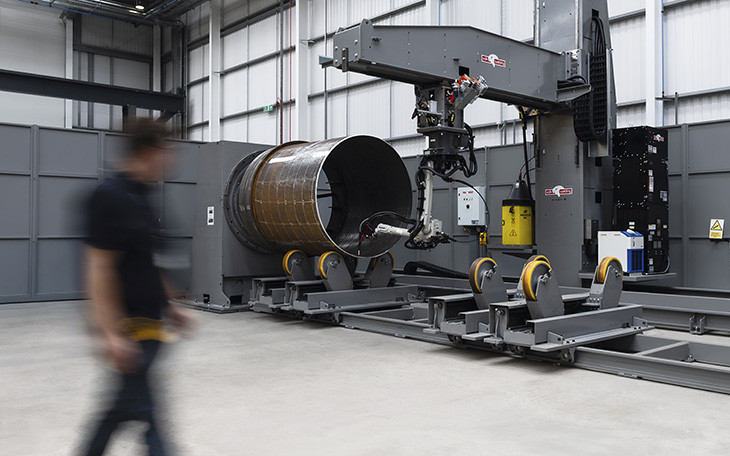
Unlike powder-bed additive manufacturing, which is generally associated with smaller, intricate components, WAAM uses an electric arc to melt metal wire and deposit material in successive layers.
The process combines principles familiar to welding engineers with robotic automation, digital manufacturing and sophisticated process control. Its appeal lies in the ability to manufacture large metallic structures without many of the tooling requirements associated with casting and forging.
But scale creates its own complications. Material behaviour, heat input, deposition consistency, geometry and subsequent machining must all be controlled throughout production. Qualification is therefore central to DEEP Manufacturing’s strategy.
The American Petroleum Institute’s API 20S standard provides an industry-specific framework for additively manufactured metallic components used in oil and gas applications. DEEP Manufacturing’s qualification activities are also aligned with DNV-ST-B203, which addresses additive manufacturing of metallic parts.
According to Richards, developing qualified processes has required extensive testing and close cooperation with DNV.
“We were pioneering something that hadn’t been done before, and without an established benchmark to work from, qualification was a lengthy and challenging process.”
DEEP Manufacturing describes its DNV approval as a significant milestone in establishing a credible manufacturing route for demanding applications. The achievement should not, however, be mistaken for unrestricted approval of every component, material or geometry the company might produce. Qualification is tied to defined processes and applicable requirements.
“Qualification doesn’t end with the certificate,” Richards explains. “We continue to follow these qualified processes throughout production.”
That distinction matters to industrial buyers. A successful demonstration establishes feasibility; a controlled manufacturing system provides a basis for repeatable procurement.
Reconsidering the economics of large metal components
The economic argument for WAAM is not simply that a robot can deposit metal quickly. Its value depends on the entire manufacturing route.
Conventional casting may require patterns, moulds and foundry capacity. Forging can involve expensive tooling, specialised facilities and additional machining. For relatively straightforward parts manufactured in large volumes, these established methods can remain highly competitive. Richards readily acknowledges their strengths.
“When it comes to relatively simple geometries and large production volumes, traditional manufacturing is still the most reasonable choice.”
The advantage changes when production volumes are limited, delivery schedules are critical or conventional processes generate substantial material waste.
DEEP Manufacturing says that, in suitable applications, WAAM can potentially reduce component lead times to approximately one-third of those associated with conventional casting or forging.
That is an application-dependent claim, not a universal manufacturing benchmark.
The company evaluates whether a component should be redesigned for additive manufacturing, whether its geometry can reduce material consumption and how much subsequent processing is required.
One important question is whether a part needs extensive machining or can be delivered closer to its deposited geometry.
The broader opportunity lies in hybrid manufacturing: combining established production methods with additive deposition to produce or modify complex structures efficiently.
Rather than replacing casting and forging across the board, WAAM may become another manufacturing option selected according to component requirements, production economics and supply-chain constraints.
A manufacturing network spanning Bristol and Houston
DEEP Manufacturing’s industrial ambitions are reflected in its manufacturing footprint.
The company’s Bristol Centre of Excellence supports process development, material qualification and large-scale production. Its capabilities have expanded to include additional manipulators, dedicated manufacturing cells and machining equipment.
The company’s manufacturing information also identifies a DMG MORI DMF 300|11 machining system, illustrating the importance of precision finishing within an additive manufacturing operation.
This is an essential part of the industrialisation story. Depositing metal does not eliminate the need for accurate interfaces, controlled tolerances or appropriate surface finishes. Machining, inspection and testing remain integral to delivering components that customers can install and operate.
Across the Atlantic, DEEP Manufacturing’s Houston operation places the company within one of the world’s most important energy manufacturing ecosystems.
“Houston is an important part of building our manufacturing capacity and supporting customers across both markets,” says Richards.
The location provides access to major operators, original equipment manufacturers, engineering expertise and established industrial services.
Richards reports growing engagement from oil and gas customers and increasing interest from the US defence sector.
The two industries share a concern with critical components, manufacturing assurance and dependable access to industrial capacity. Defence’s experience with qualified additive manufacturing may therefore offer useful lessons for energy operators assessing unfamiliar production technologies.
For DEEP Manufacturing, the objective is not merely to establish machines in different countries. It is to develop manufacturing operations supported by qualified local suppliers and the capabilities required to deliver finished components.
The industrial ecosystem behind the robot
A large WAAM installation may be the most visible part of the production process, but the wider technology ecosystem is no less important.
Materials must be qualified. Robotic welding equipment must operate consistently. Deposited structures may require machining, heat treatment, destructive testing and non-destructive examination before delivery.
DEEP Manufacturing works with several specialist organisations across this manufacturing chain.
Richards specifically identifies Plastometrex, whose materials-testing technology has helped the company reduce the time required for material testing and qualification.
The commercial significance is considerable. Faster manufacturing provides limited benefit if material characterisation and qualification remain prolonged bottlenecks.
Valk Welding supplies robotic welding systems supporting DEEP Manufacturing’s large-scale WAAM capabilities. Such equipment forms part of the automated production infrastructure needed to translate controlled deposition processes into industrial manufacturing operations.
DNV has played a different role, working with DEEP Manufacturing on the qualification framework necessary for safety-critical applications.
Beyond these relationships, public project information identifies additional organisations involved in DEEP Manufacturing’s technology development.
Fortius Metals has collaborated with DEEP Manufacturing on multi-material WAAM development, an area with potential implications for component performance and manufacturing flexibility.
Meanwhile, the presence of DMG MORI machining technology underlines the continuing relationship between additive deposition and conventional precision manufacturing.
These are distinct technical relationships, not interchangeable supplier roles. Together, however, they demonstrate why industrial additive manufacturing depends on more than a printing system.
As DEEP Manufacturing expands, Richards expects local supply-chain capability to become increasingly important.
Where qualified suppliers cannot provide essential services, the company may need to develop additional capabilities internally.
A marine propeller demonstrates the possibilities
One of DEEP Manufacturing’s more revealing projects comes from the maritime sector.
As part of the Innovate UK-supported Digitally Enabled Efficient Propeller project, DEEP Manufacturing manufactured a section of a marine propeller blade using Nickel Aluminium Bronze (NAB).
The project, led by Enki Marine, brought together Stone Marine Propulsion, TWI, Authentise, ASTM International and Newcastle University alongside DEEP Manufacturing.
The objective was not simply to reproduce a conventional propeller by a different manufacturing method. It was to investigate whether WAAM could enable geometries that would be difficult to achieve through traditional casting.
The resulting demonstrator incorporated an internal cavity, opening possibilities for future lightweight structures, acoustic performance improvements and embedded monitoring technologies.
The technical development involved optimising deposition parameters and examining material behaviour through mechanical, fatigue and corrosion testing, as well as microstructural analysis.
DEEP Manufacturing reports that the project established an encouraging foundation for producing high-integrity marine components using WAAM.
Crucially, it remains a feasibility demonstration rather than proof of a propeller already operating commercially at sea.
Its wider significance lies in demonstrating how additive manufacturing can influence component design itself, rather than merely replacing one production technique with another.
When additive manufacturing becomes ordinary
The next phase of large-scale metal additive manufacturing will be determined less by increasingly spectacular demonstrations than by the accumulation of credible operational evidence.
Industrial buyers will want to understand how parts perform in service, how consistently they can be manufactured and whether the total economics justify adopting a different production route.
Standards, qualified processes, capable suppliers and efficient manufacturing networks will shape those decisions.
For DEEP Manufacturing, further certification, continued materials development and expanded manufacturing capability remain important priorities.
Yet Richards believes that the clearest indication of success will be less dramatic.
“We need additive manufacturing to become ‘boring’,” he says, recalling a remark made by one of the company’s engineers.
It is a revealing ambition for an industry frequently associated with technological spectacle.
The ultimate achievement would be a point at which WAAM is no longer regarded as an exceptional process requiring special justification, but as an established manufacturing option considered alongside casting and forging.
For critical industries, that transition will depend not on how convincingly metal can be printed, but on how reliably the resulting component can be delivered, qualified and trusted.